
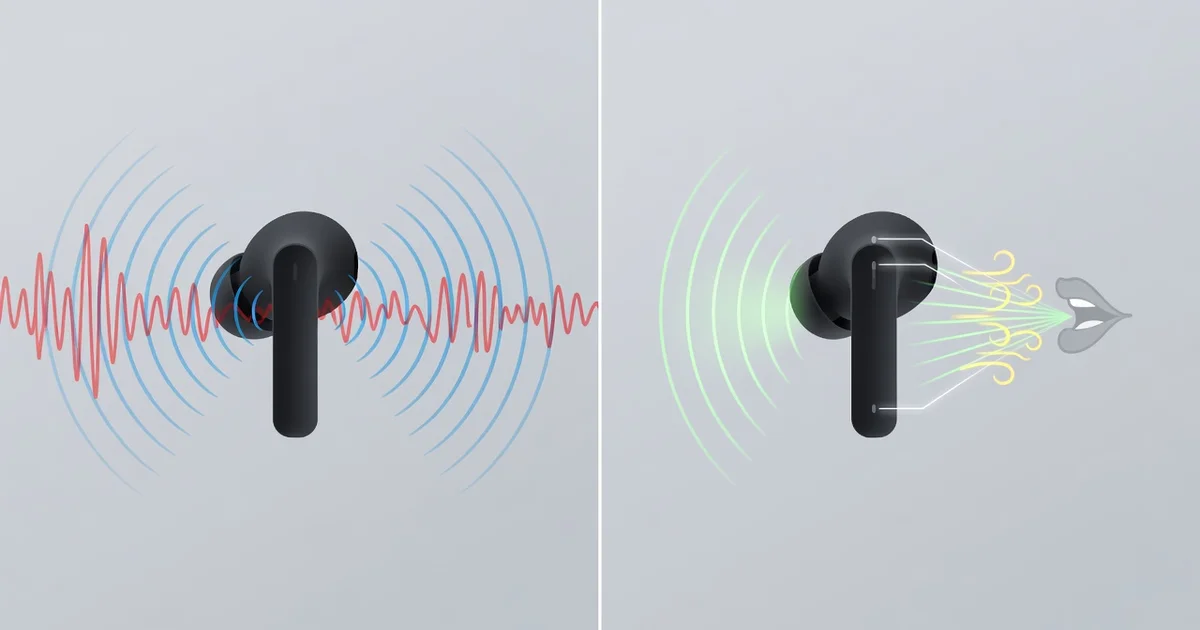
Shopping for wireless earbuds can feel overwhelming when spec sheets are packed with acronyms. Two terms you’ll see constantly are ANC and ENC—and while they sound similar, they solve very different problems. Understanding the difference between ANC and ENC helps you pick earbuds that match how you actually use them.
In short, one is designed for your ears, the other for your voice. This guide breaks down how each technology works, when you’ll notice it, and which features matter most for calls, commutes, and noisy workplaces.
Introduction
Wireless earbuds have become one of the most common personal audio devices in everyday life, and their spec sheets are often filled with acronyms that sound similar but mean very different things. Two of the most frequently confused terms are ANC and ENC. This article explores The Difference Between ANC and ENC in Wireless Earbuds with clear, practical guidance, so you can stop guessing what those labels actually do and start choosing earbuds that match how you really use them.
Understanding the fundamentals of The Difference Between ANC and ENC in Wireless Earbuds helps you make informed decisions, whether you are buying your first pair, upgrading to a premium model, or trying to figure out why call quality still sounds poor on a pair advertised as “noise cancelling.” Reliable information and consistent habits lead to better long-term outcomes, both in the money you spend and in how satisfied you are with your device over months of daily use.
At a glance, ANC stands for Active Noise Cancellation and is designed to reduce the noise reaching your own ears. ENC stands for Environmental Noise Cancellation and is designed to reduce the background noise that reaches the person on the other end of your call. They solve two different problems, use different microphone arrays, and are marketed with overlapping language that often blurs the line between them.
Key Concepts
Before comparing the two technologies directly, it helps to separate the basic concepts that make each one work. Both rely on microphones and digital signal processing, but the target of that processing is completely different.
What ANC actually does
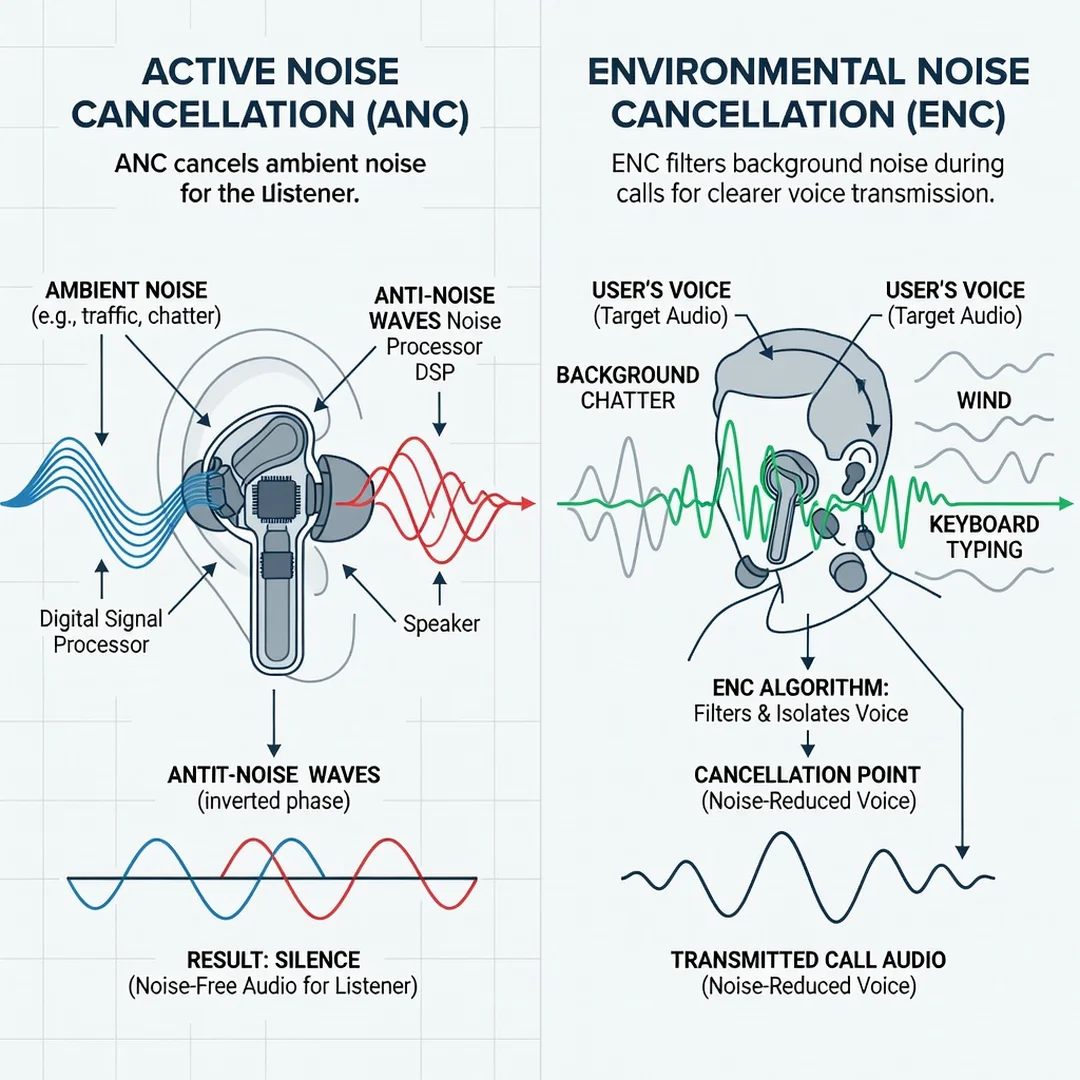
Active Noise Cancellation uses microphones on the outside and sometimes the inside of the earbud to sample ambient sound, then generates an inverted sound wave that cancels out part of that noise before it reaches your ear drum. This is why ANC is most effective against steady, low-frequency sounds such as airplane engines, train rumble, air conditioning hum, and the drone of a bus. It is far less effective against sudden, high-frequency sounds like a baby crying or a chair scraping the floor.
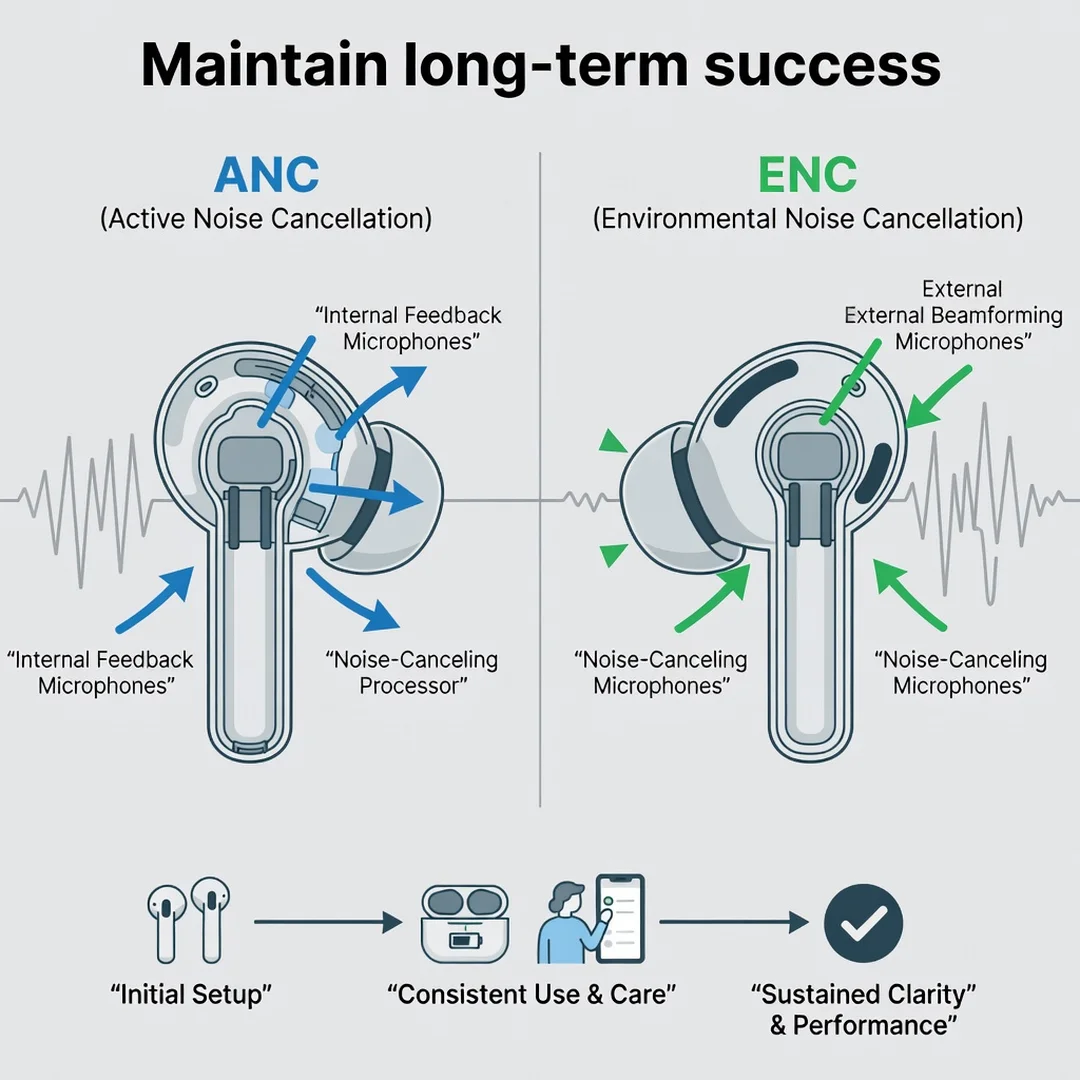
- Feed-forward ANC: microphones sit on the outside of the earbud and sample noise before it enters.
- Feedback ANC: microphones sit inside the ear canal and measure what actually reached your ear.
- Hybrid ANC: combines both approaches and is generally the most effective.
- Adaptive ANC: continuously adjusts the cancellation level based on your environment and fit.
What ENC actually does
Environmental Noise Cancellation uses a separate set of microphones, usually positioned to pick up your voice, and applies algorithms that isolate speech from surrounding noise. The cleaned-up voice signal is then transmitted to the person you are calling. ENC does very little for what you hear; it exists to improve what others hear when you speak. In practice, ENC is the technology behind claims like “crystal-clear calls” and “beamforming microphones.”
Why the confusion exists
Many budget earbuds advertise “noise cancellation” without specifying which type. Some list “ANC for calls,” which is really ENC. Others list “ENC” while implying it silences your environment. Reading the fine print, checking the microphone count, and looking at what the feature is described as doing are the fastest ways to tell them apart.
Deep Dive
Now that the concepts are clear, the real differences become easier to map onto daily use. This section breaks down where ANC and ENC diverge in hardware, performance, and practical impact.
Different goals, different hardware
ANC needs microphones that face the outside world to capture ambient noise, plus processing power to generate anti-noise in real time. Because it alters what you hear, it also requires a good seal between the earbud tip and your ear canal; a poor fit can reduce ANC effectiveness by half or more. ENC needs microphones aimed at your mouth or positioned along the stem to pick up your voice, plus algorithms such as beamforming, noise gating, and wind reduction. Because it alters what others hear, its effectiveness depends on microphone placement and call processing rather than ear tip seal.
Performance in real environments
- On a plane or train: ANC is the star. ENC does almost nothing for your listening comfort.
- On a noisy street call: ENC is the star. ANC may reduce what you hear, but the caller still hears the traffic unless ENC is doing its job.
- In a windy outdoor walk: ENC with wind-noise reduction matters most for calls; ANC may struggle because wind confuses external microphones.
- In a quiet office: ANC can reduce HVAC hum, while ENC helps your voice stand out on video meetings.
Battery and processing trade-offs
ANC is power-hungry because it runs continuously while enabled. Turning it on can reduce battery life noticeably, which is why many earbuds let you toggle it or use an adaptive mode. ENC typically activates during calls, so its battery impact is smaller and less noticeable in day-to-day use. This is one reason a pair with excellent call quality may still have average ANC, and vice versa.
How to read marketing claims
A claim like “up to 40 dB noise reduction” almost always refers to ANC and is measured under ideal lab conditions. A claim like “AI ENC for clear calls” refers to call clarity. When a product page lists both, check which one is tied to listening and which is tied to calling. If only one is mentioned, assume the other is weak or absent.
Best Practices
Knowing the difference is useful, but applying it well is what actually improves your experience. These best practices help you get the most from whichever technology your earbuds include.
- Match the feature to the task: use ANC when you want to block out engine noise or hum, and rely on ENC when call clarity matters most.
- Test the fit first: ANC performance collapses with a loose seal, so try different ear tip sizes before judging the earbuds.
- Toggle ANC when battery matters: on long trips, switching to a lower ANC level or off entirely can extend listening time significantly.
- Take calls in less chaotic spots when possible: even good ENC struggles in extreme wind or very loud crowds.
- Check microphone placement: stem-style earbuds often pick up voice better than fully in-ear designs with tiny internal mics.
- Update firmware: call processing and ANC algorithms are frequently improved through software updates after launch.
These habits are simple, but consistent use of them leads to better long-term outcomes than chasing spec numbers alone.
Step-by-Step Guide
If you want a structured way to evaluate ANC and ENC in a pair of earbuds, follow these steps in order.
Step 1: Understand the fundamentals
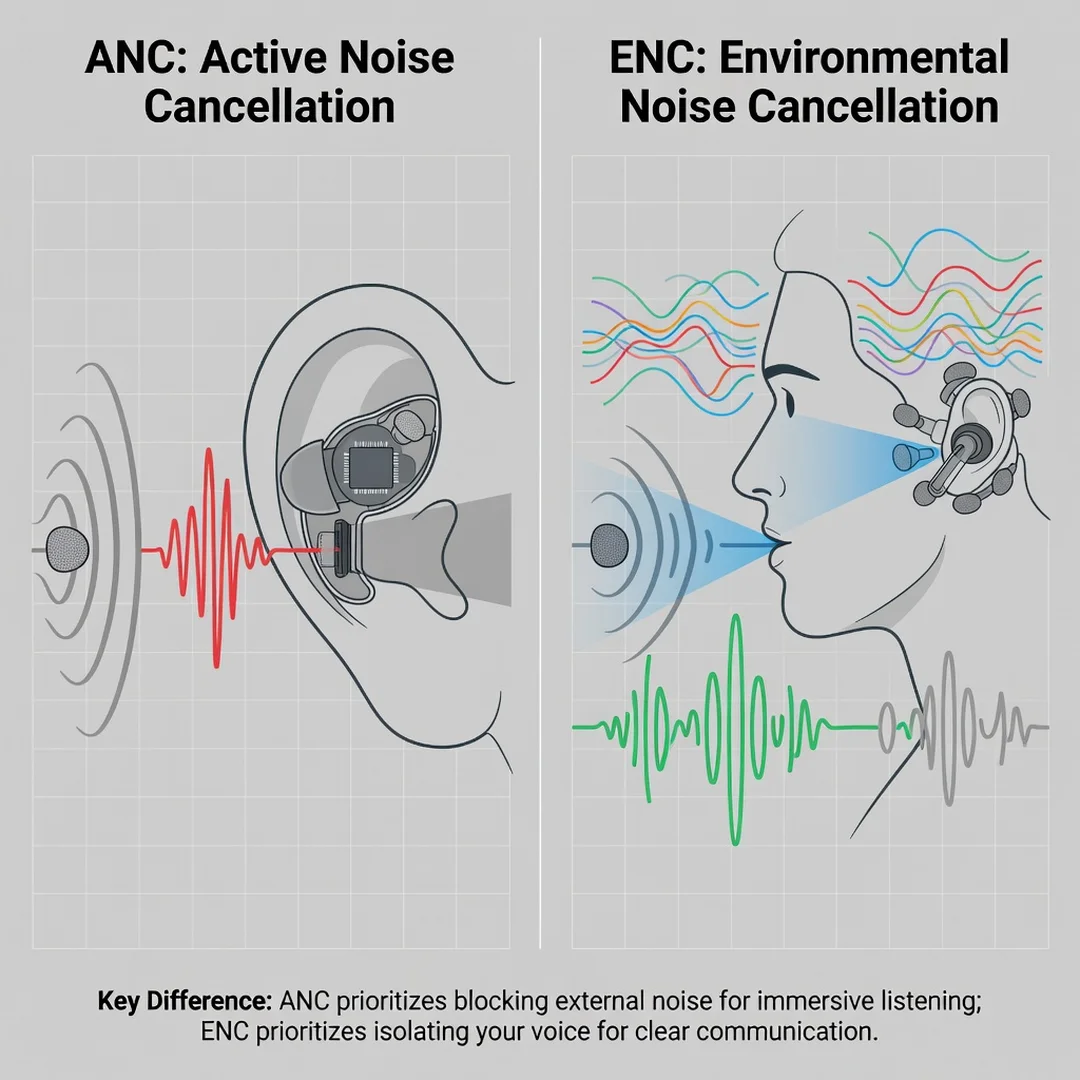
Confirm that ANC affects what you hear and ENC affects what callers hear. Write down which one matters more for your primary use, whether that is commuting, working in a shared office, taking client calls, or listening in bed. This single clarification prevents most buying mistakes.
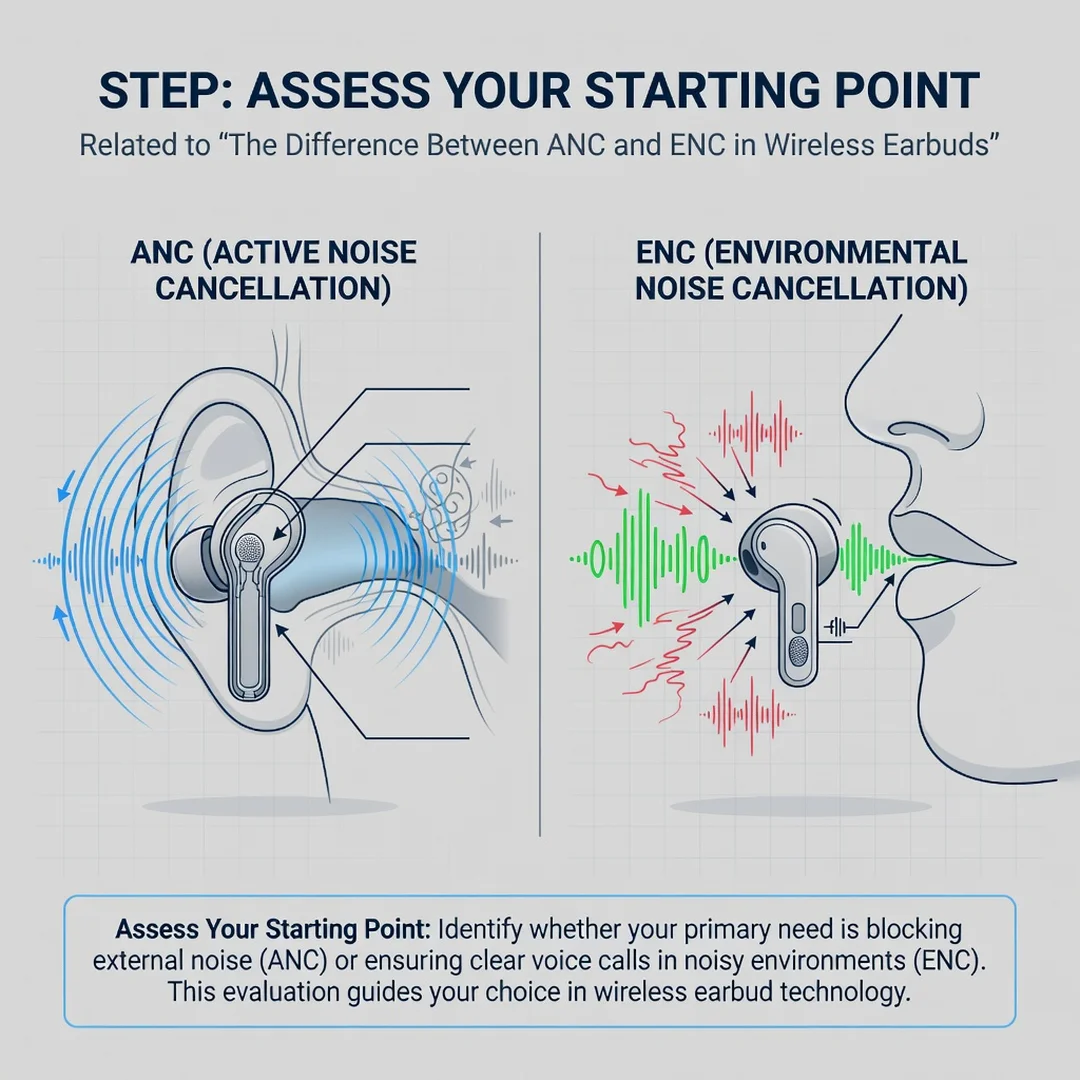
Step 2: Assess your starting point
Look at your current earbuds or the models you are considering. Count the microphones and note their positions. Check whether the product page mentions “noise cancellation for listening” versus “noise cancellation for calls.” If the wording is vague, search for independent reviews that test call quality and ANC separately.
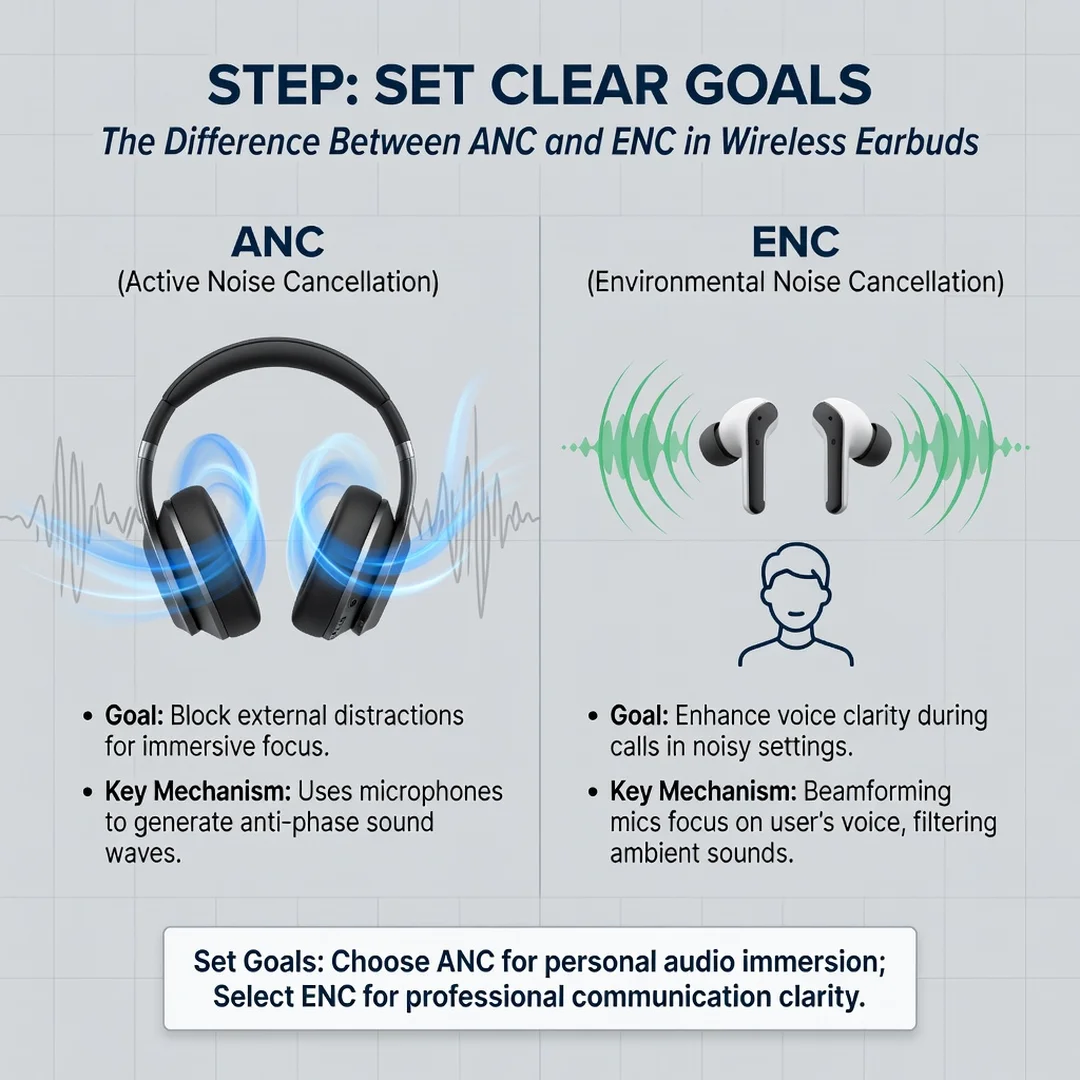
Step 3: Set clear goals
Decide what success looks like. Examples: “I want to mute airplane noise enough to sleep,” “I want colleagues to hear me clearly on video calls from a cafe,” or “I want both, but call quality is non-negotiable.” Ranking these priorities tells you whether to pay a premium for hybrid ANC or for advanced ENC.
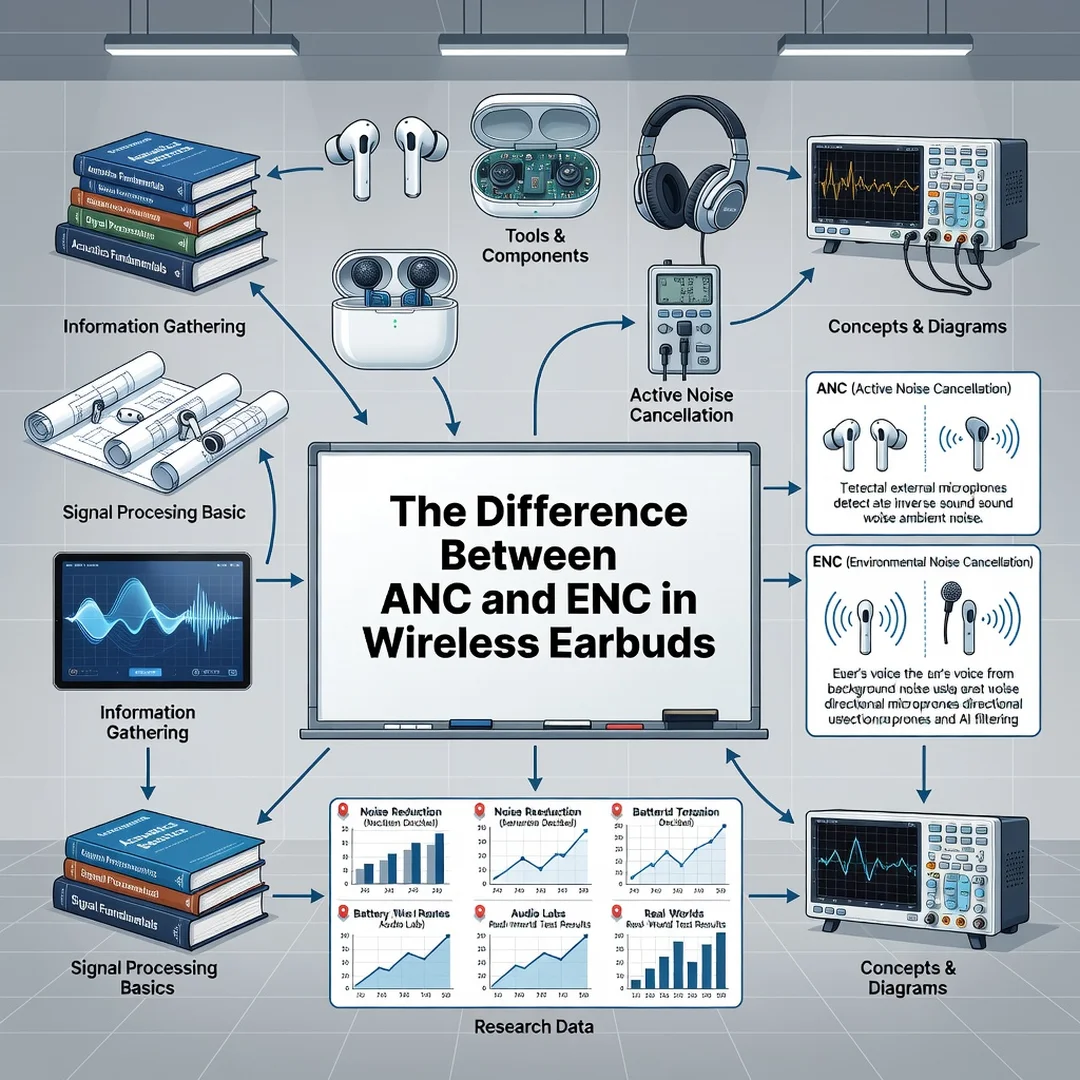
Step 4: Gather necessary resources
Collect what you need to evaluate properly: a quiet room for baseline tests, a noisy environment for real-world tests, a friend willing to take a call and report how you sound, and your phone or laptop with the earbuds’ companion app installed. If possible, borrow or try a demo pair before committing.
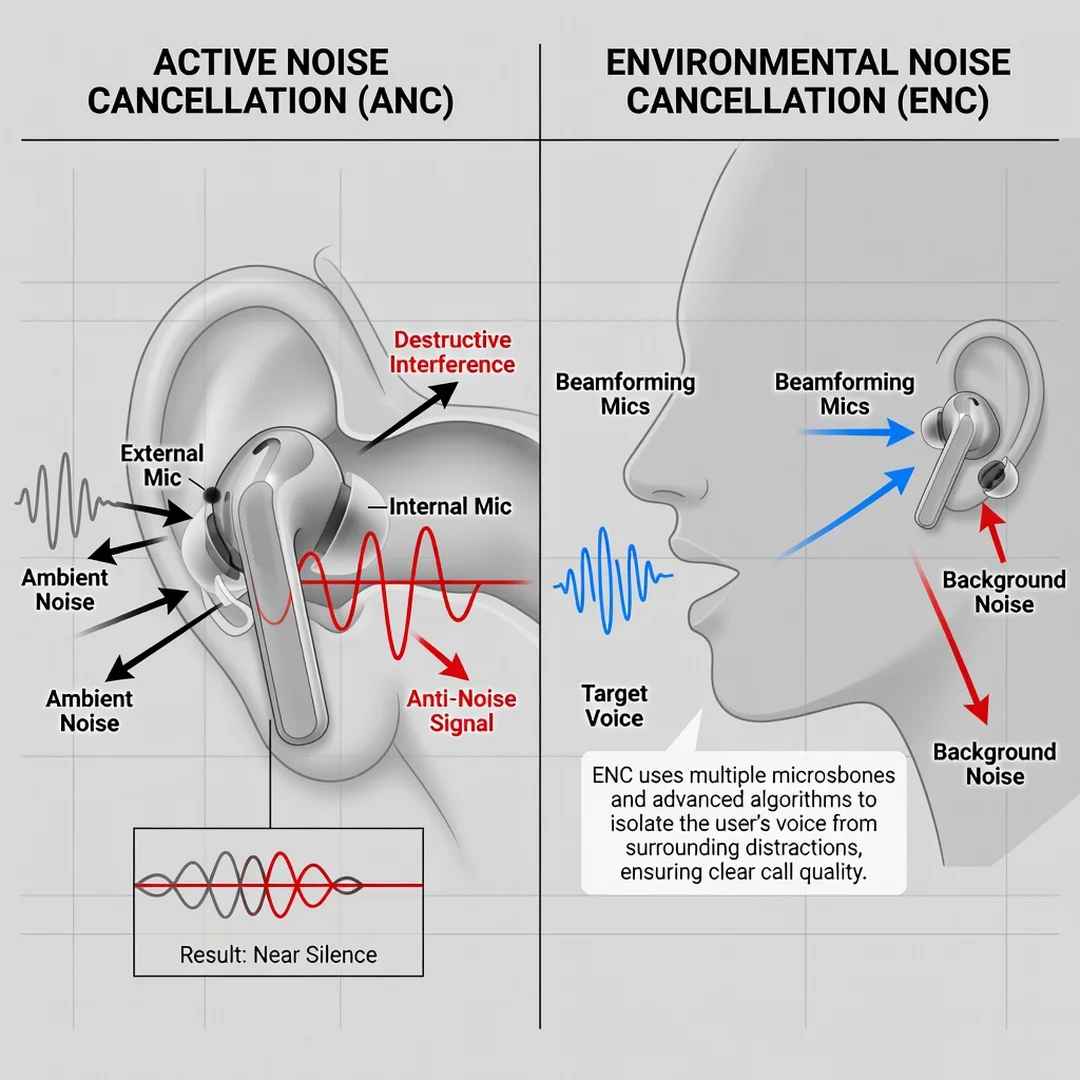
Step 5: Apply the core methods
Run two separate tests. First, enable ANC in a steady-noise environment and note how much the rumble fades. Second, make a call from a noisy spot and ask the listener to rate your voice clarity with ENC on and off. Keep the results separate in your notes, because a strong result in one test says nothing about the other.
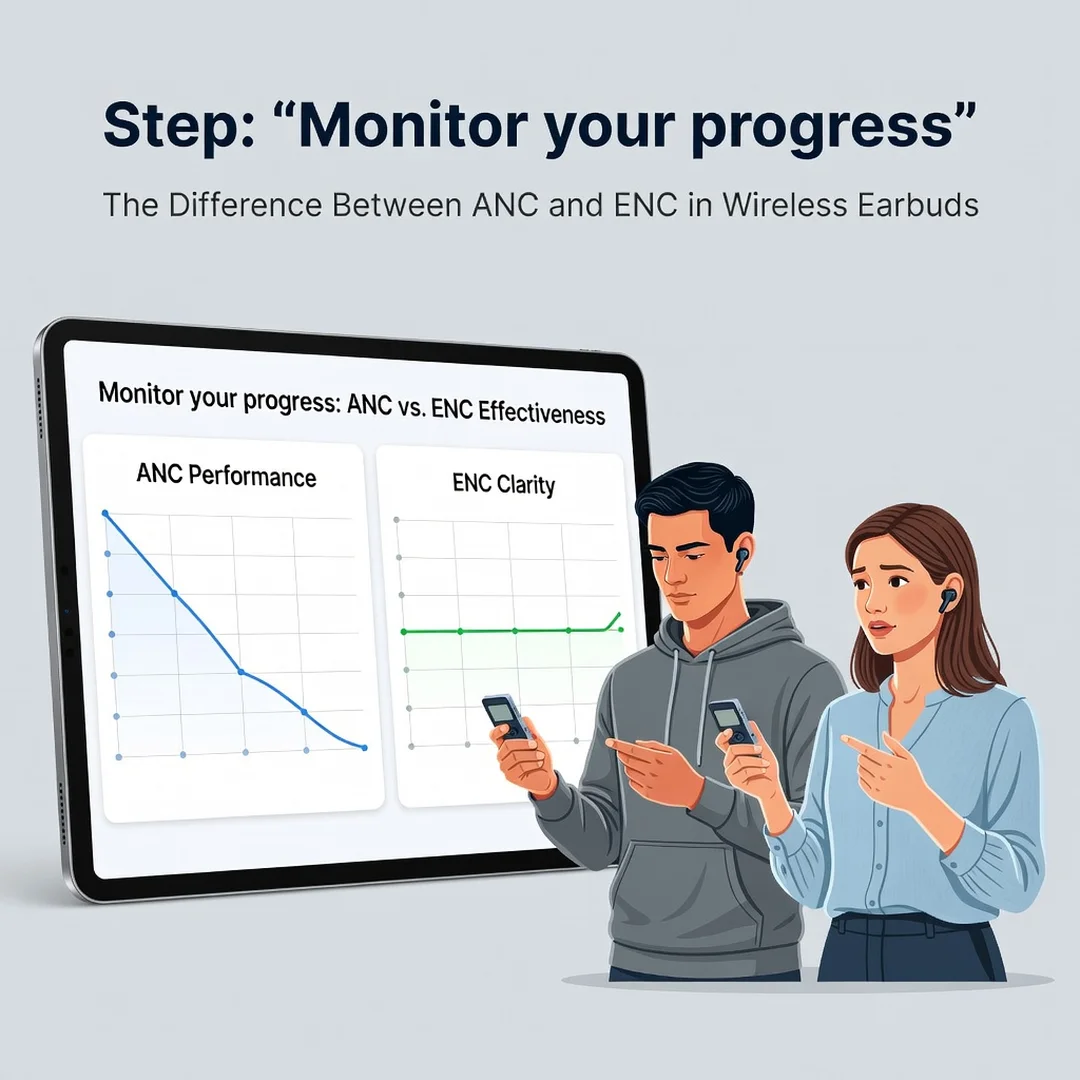
Step 6: Monitor your progress
After a week of daily use, review whether the earbuds are actually solving your original problem. Adjust ear tips, firmware, and settings as needed. If ANC or ENC consistently underperforms your goal, return or exchange the device while you still can, and use your notes to choose a better match next time.
FAQ
What should I know about The Difference Between ANC and ENC in Wireless Earbuds?
The single most important point is that ANC and ENC serve opposite sides of a conversation. ANC reduces noise reaching your ears so you can hear your music or podcast more clearly. ENC reduces noise reaching the other person’s ears so your voice sounds clearer on calls. They are not competing versions of the same feature, and a pair with great ANC may have mediocre ENC. When shopping, look for both if you care about listening and calling, and treat any product that mentions only one as likely weak in the other. Also remember that ANC depends heavily on a good ear tip seal and works best against steady low-frequency noise, while ENC depends on microphone placement and call processing and works best in moderate background noise.
Who is this guide for?
This guide is for anyone comparing wireless earbuds and feeling confused by the acronyms on the box. That includes commuters who want to block out engine noise, remote workers who spend hours on calls, students studying in noisy environments, and gift-buyers trying to pick the right pair for someone else. It is also useful for people who already own earbuds and want to understand why call quality and noise cancellation seem inconsistent. No technical background is required; the steps focus on practical testing and clear priorities rather than engineering details.
Conclusion
You now have a solid foundation for The Difference Between ANC and ENC in Wireless Earbuds. Apply the best practices above and revisit this guide as your needs evolve.